
'SPIRITS OF ST. HELENA'
CEMETERY TOUR IS NOW HISTORY

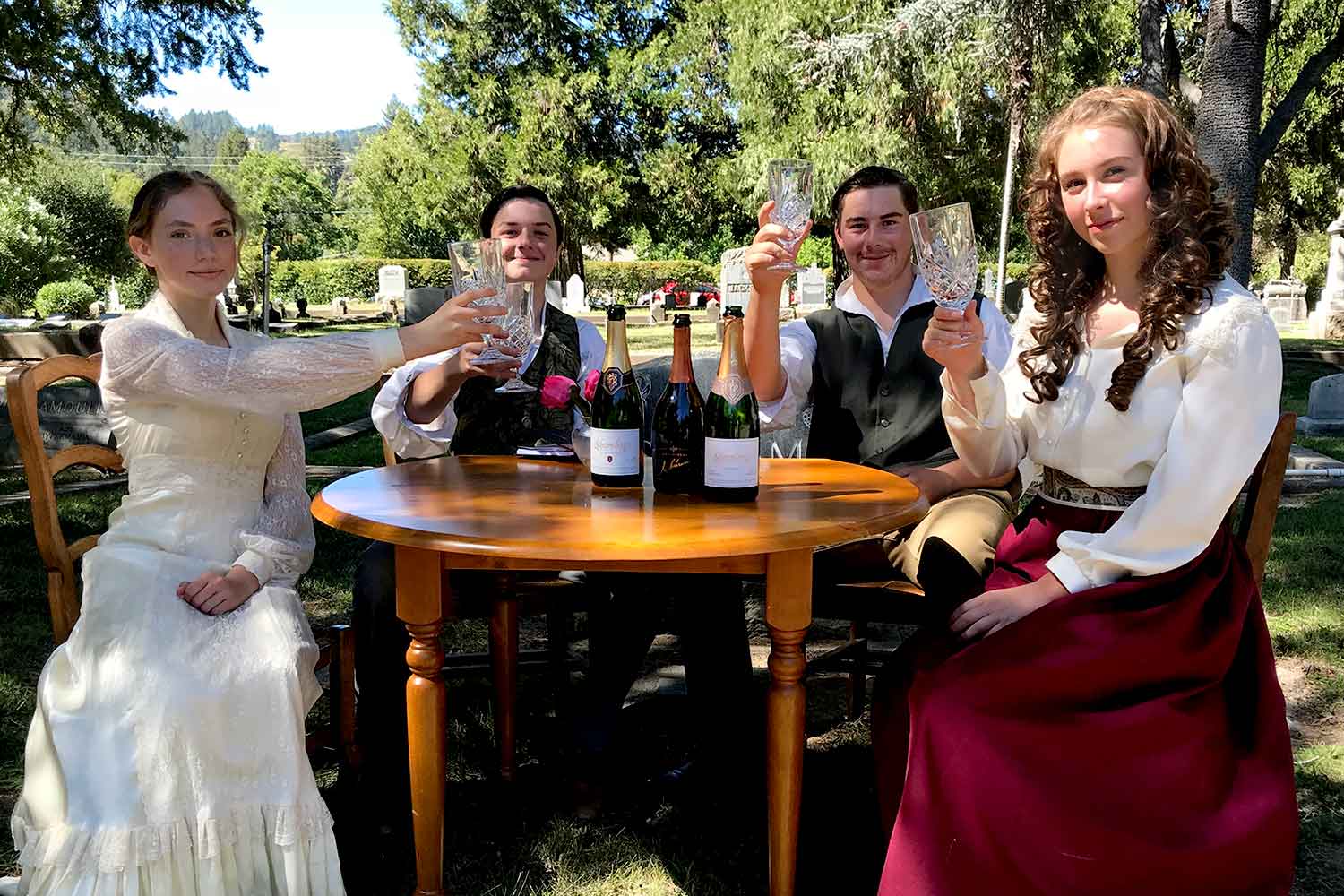
The Society presented its fifth annual “Spirits of
St. Helena” Cemetery Discovery Walk at St. Helena
Cemetery on November 3. It was a beautiful, warm
fall day and over 50 people enjoyed the tour. The
gravesites were closer together this year, making it
easier to walk from one to another.
Our actors this year were:
Lowell Smith as Jules Millet, Kathy Kernberger as
aunt of Richard Fealy, Bill Savidge as Alfred Cook,
Jeff Farmer as George Clark, Marilyn Coy as
Victorina Sasselli and John Ponte as John Wright.
Most of the stories involved a murder, which was
more common in St.Helena in the nineteenth century
when most people carried a gun.
Former St. Helena mayor Lowell Smith began the tour
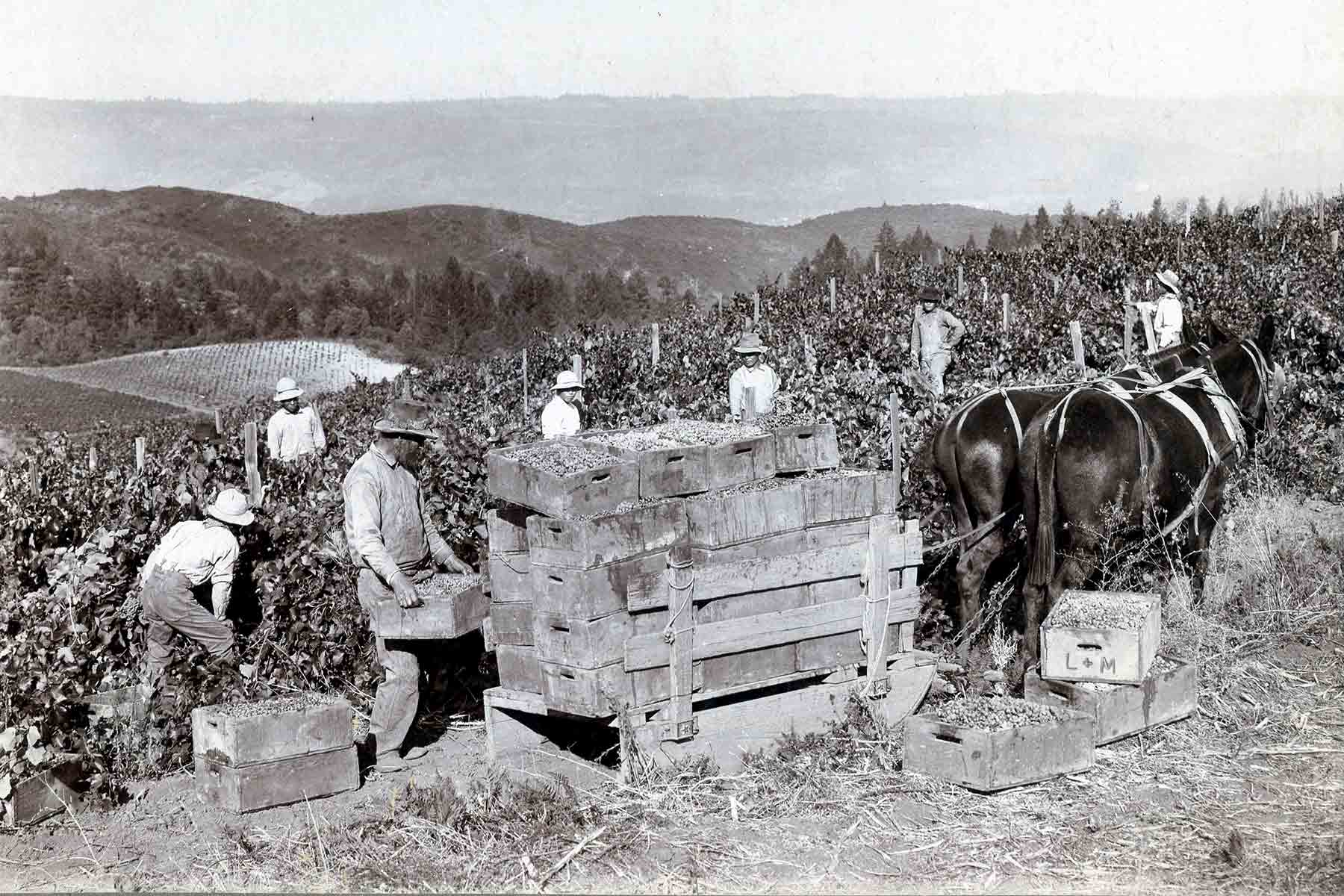
as Jules Millet, who had arrived here from France
only three months prior to his murder with a wife
and small daughter. Jules was the nephew of Germain
Crochat, partner in the Franco-Swiss Winery in
Conn Valley. He lived and worked
at the winery, as did John Murbach (murderer).
One day the photographer R.E. Wood came to take
photos of the winery. Whilst he was away from his
wagonload of equipment, John Murbach stole several
photographs and hid them. The theft was promptly
noticed and Murbach was the only suspect as he was
seen near the wagon. Incensed winery partner Fred
Metzner extracted a confession, severely beat
Murbach, fired him and ejected him from the
property. Murbach returned one week later on
November 26, 1882 with a gun, looking for Metzner
and found the hapless Millet first. He shot Millet,
who died soon after. At the trial Murbach was
convicted of murder and sentenced to hang.
Historian Kathy Kernberger portrayed the aunt of
Richard Fealy, who was in reality related to Kathy.
Fealy was in trouble for much of his life, beginning
with misbehaving at Liberty School and leading to
committing arson to collect insurance money. At the
age of 18 he was charged with assault.
In early 1915 Richard came up with a plan for a
“mysterious” fire to burn down the house of his
mother-in-law, who lived across the street from
Grandview in St. Helena. She did not want her
valuable furniture to be destroyed, so he agreed to
remove it from the house. Neighbors and friends
helped to move the furniture to a barn in Rutherford on his family’s ranch. Having emptied the house, Richard laid a trail
of gasoline from a pile of rags to a burning candle.
Then he, his wife, sons and mother-in-law went for a
“picnic” in the dark.
Unfortunately for Richard, the volunteer fire
department was having a dinner at Grandview (then
known as St. Gothard’s Inn) across the street.
Seeing the candle, they went to investigate and
found the incendiary device. He might have escaped,
but he filed an insurance claim. Richard was
convicted of arson and insurance fraud, serving six
years at San Quentin Prison.
Former city councilman Bill Savidge portrayed Alfred
Cook, who was shot by Jesse Walters on January 8,
1899.
There was gunplay in Napa one morning and when the
smoke cleared Alfred Cook, formerly a barkeeper in
St. Helena and Oakville, was dead. Jesse Walters, at
one time deputy sheriff in Yountville, had a bullet
in his knee.
Sheriff Dunlap arrived at George McKenzie’s livery
stable, he found the deceased Cook, who had been
braiding rope in a box stall, lying on the floor
with multiple gunshot wounds and holding a revolver
with four empty chambers.
The first version of the affair was that Walters,
seeing ex-sheriff Mackenzie in front of the latter’s
livery stable, crossed the street to speak to him
regarding a harness. Cook, who was in the rear of
the stable, started shooting and that Walters
returned the fire. The case took a sensational turn
when the coroner’s jury brought in a verdict
charging Walters with the murder of Cook, six jurors
adding a finding that McKenzie was an accessory
after the fact.
There had been bad blood between Cook and Walters
for some time. Cook was known as the partying
bartender, had been accused of forgery and other
misdeeds. Walters had been heard threatening to kill
Cook if he ever came back to Napa and he was true to
his word.
In the end, Cook’s shot lodged in Walter’s knee and
got infected. Whilst he was in jail after being
arrested, his knee had to be amputated. Walters got
sicker and on his deathbed confessed to killing
Cook.
Jeff Farmer portrayed George Clark, who murdered his
brother on January 19, 1898.
William Anderson Clark, 43, a railroad section hand
who carried his lunch to work, found his coffee
unduly bitter one day. He brought it to be analyzed
by W.H. Smith, the druggist, who found it to contain
5 grams of strychnine (enough to kill several men).
Clark purchased a new container for his coffee, but
two weeks later had the same experience. He was
unable to explain the matter.
On the fateful
morning at 5am Clark was preparing his breakfast
when there came a knock on the door. When he opened
it he was shot with a revolver. William Clark left a
widow with seven children. The man’s brother George,
35 years old, was suspected by Marshal Johnson and
was arrested immediately.
In the accused’s room
was found a box of cartridges with 5 shells missing
and note purporting to be a suicide note from the
victim. It said he was tired of life and that a
bottle of strychnine could be found behind the clock
and box of cartridges in the basement. In the margin
was written “Tell George he is innocent”
While in jail in Napa
George (who was very religious) was visited by a
clever reporter from the Examiner, who asked
him to place his hand on the bible and asked him to
swear that he did not kill his brother. Clark
finally confessed and related that he had been in
love with his brother’s wife since he was a boy. He
had a love affair with her over the last 14 years.
He said she promised to marry him if her husband
ever died.
When they lived in
Pope Valley, George burned their
house down hoping they would move to St. Helena. At
the trial Mrs. Clark said she had known George since
he was a child. She admitted to the intimacies
between them. The officers built a strong case and
George was found guilty of first degree murder and
executed at San Quentin. Thus ended the family
triangle.
Retired teacher
Marilyn Coy portrayed Victorina Sasselli, who was
murdered at the age of 17 on March 18, 1898.
Victorina was the eldest daughter of Swiss-Italian
immigrants, Joseph and Frederica Sasselli who
arrived in the Napa Valley in 1888. She was born in
Switzerlandi in 1880. Their property consisted of 92
acres and was located adjacent to of their dear
neighbors and friends, the Anton and Caterina
Nichelini family, on Sage Canyon Road.
Mr. Jules Bheud was a
drifter and much of the time jobless. He became
obsessed with Victorina and had come to the
house to request that he be able to court her. Each
time he was turned away by her parents.
On the fateful day
Victorina and her father were returning from a
shopping trip in St. Helena when they came upon Mr. Bheud. He had rented a livery rig and had
apparently driven to their home and, finding that
Victorina was not at home, began to make his way
back toward
St. Helena. Upon meeting Joseph
and his daughter he made polite conversation and
convinced them that he only wanted a short
conversation with her and would bring her directly
home.
As they approached
Horse Shoe Bend, Mr. Bheud pulled a revolver and
pleaded with Victorina to become his wife. If she
refused, he would kill himself. She tried to
convince him that he had a whole life ahead of him
and that there were many young ladies who would be
available for marriage. But he suddenly turned the
revolver toward her and shot her. He then shot
himself, dying almost instantly.
The horses raced up
the road with Victorina lying on the floorboards of
the rig. Her life was draining slowly away. As the
horses approached the home of the Nichelini family,
Caterina Nichelini raced out to stop them, knowing
something was terribly wrong. Upon finding her,
Caterina cradled Victorina in her arms as she took
her last breath. Both Sasselli and Bheud are buried
at St. Helena.
A note was later
found addressed to her mother. It read:
"Madame Sasselli: I
am writing to you for the purpose of demanding your
pardon for the act that I have intention of doing.
I would rather die with her than be separated from
her. I love her too much to see her in the arms of
another.Yours devotedly, Jules Bheud."
John Ponte portrayed
John Wright, who was lynched and hung from the York Creek Bridge on May 5, 1888.
Robert M. “Budd” Vann
was a son of a prominent St. Helena family. He was
also a customer at the Pink Saloon, bar and brothel
located in town. Budd was said to be a overweight,
overbearing barfly. He was attracted to one of the
“employees” of the saloon, who did not welcome his
attention. One day he arrived loud and drunk when
John Wright, brother of the lady, tried to prevent
him from entering. He forced his way inside. Wright
shot and killed him.
Young 18 year old
Wright appeared before Judge Elgin, with the
district attorney examining him. He was without a
lawyer to represent him and barely spoke. Twelve
witnesses were called against him, but it was next
to impossible to get anything out of them.
Afterwards, Wright was locked in the jail by
Constable McGee. Both the Constable McGee and Night
Watchman York tried to tell District Attorney and
Judge Elgin that there would be trouble and that
they should post extra guards - word even got all
the way down to Napa and the Sheriff. Neither of
them believed St. Helenans would do anything.
The Constable had
managed to slip the Judge the keys to the jail
hoping he could keep them safe, but somehow Vann’s
friends knew. A group of 15-20 masked men went to
Judge Elgin’s home and demanded the keys. Night
Watchman York found the jail broken into and me
gone, but could not find out where. In the morning
Mr. Beringer came down and told them where to find
the body, hanging from the York Creek Bridge. It took an extra
hour and a half for District Attorney Hogan to come
by and have it removed. The St. Helena Star
editorial condemned the rash act. The incident was
reported all over the state and internationally.
Both Vann and Wright are buried in St. Helena
cemetery.
The “Spirits of
St. Helena” Cemetery Discovery
Walk takes place the first Saturday in November of
every year. Watch for it next year.
"Since 1856 people from all walks of life have
been buried at the Saint Helena Cemetery. They were
famous, infamous and ordinary folk,"
explains Mariam Hansen of the St. Helena Historical
Society. "We selected fascinating biographies
of people from many eras who ended their life’s
journey in St. Helena”
she continued. ”Some of these stories are so
amazing, you have to hear them to believe it"
adds Kathy Kernberger, who did much of the research.
For photos from the tour see our
NEWS page.
 |